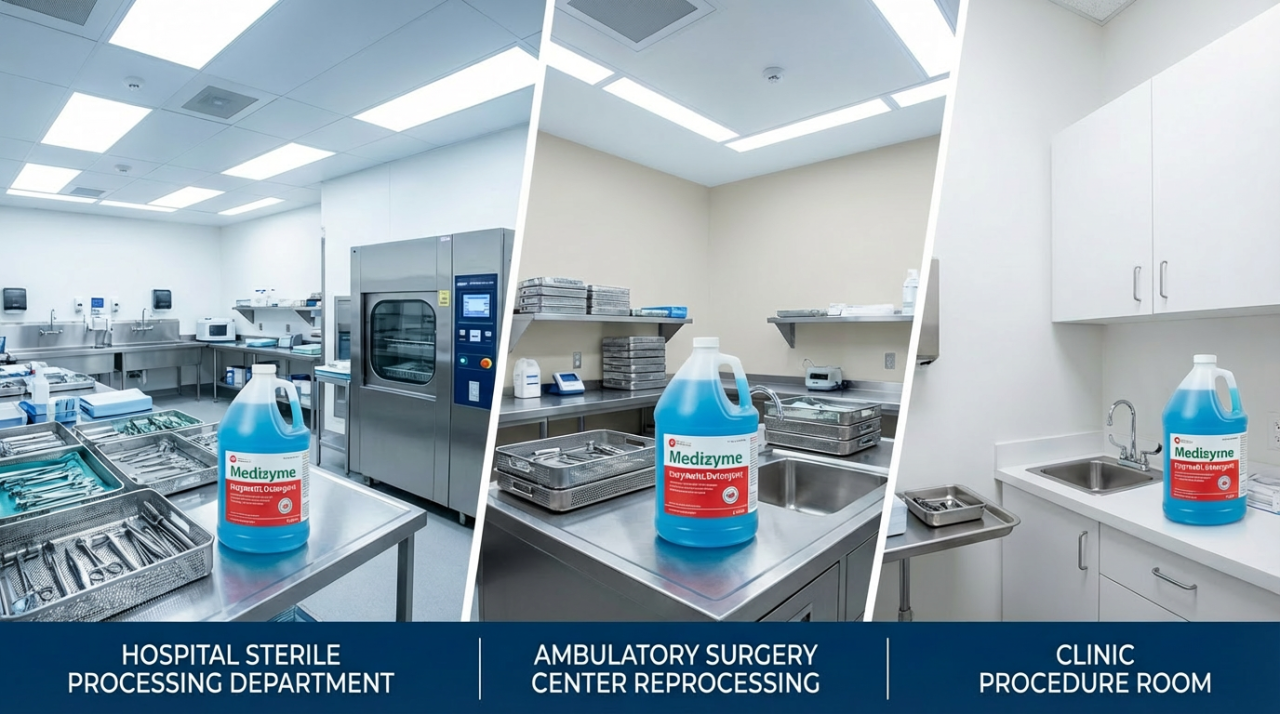
Medizyme - Multi-Enzymatic Cleaner Guide for Medical Instrument Reprocessing
Medizyme is used in many sterile endoscope reprocessing departments of all sizes because it's practical, predictable, and easy to standardize. This overview focuses on real-world effectiveness. (The how, why, what and when)
When a medical facility is trying to reduce rework, shorten turnaround, and protect their investment into the medical devices they use, the early cleaning steps matter. Medizyme is an enzymatic cleaner that your team should evaluate, especially because the same product needs to support consistent performance across multiple shifts.
Where Medizyme Fits in Your Reprocessing Workflow
Most medical departments place Medizyme early in the cycle so soils don't get a chance to harden. That early cleaning step helps keep later stages consistent, especially when staffing is tight.
Many managers view this stage as the make-or-break moment for predictable performance. If you view tray turnaround as a KPI, it's also the easiest place to improve cleaning without changing the rest of the cycle.
One practical habit that helps: document the setup (dilution, temperature guidance, and contact time) so new staff aren't guessing.
Medizyme is a neutral‑pH detergent designed for the pre‑cleaning stage of reusable medical and surgical instruments. That neutral profile helps support instrument life while still giving staff a predictable, repeatable cleaning step at the sink or in the decontamination area.
Cleaning Performance Across Water Types
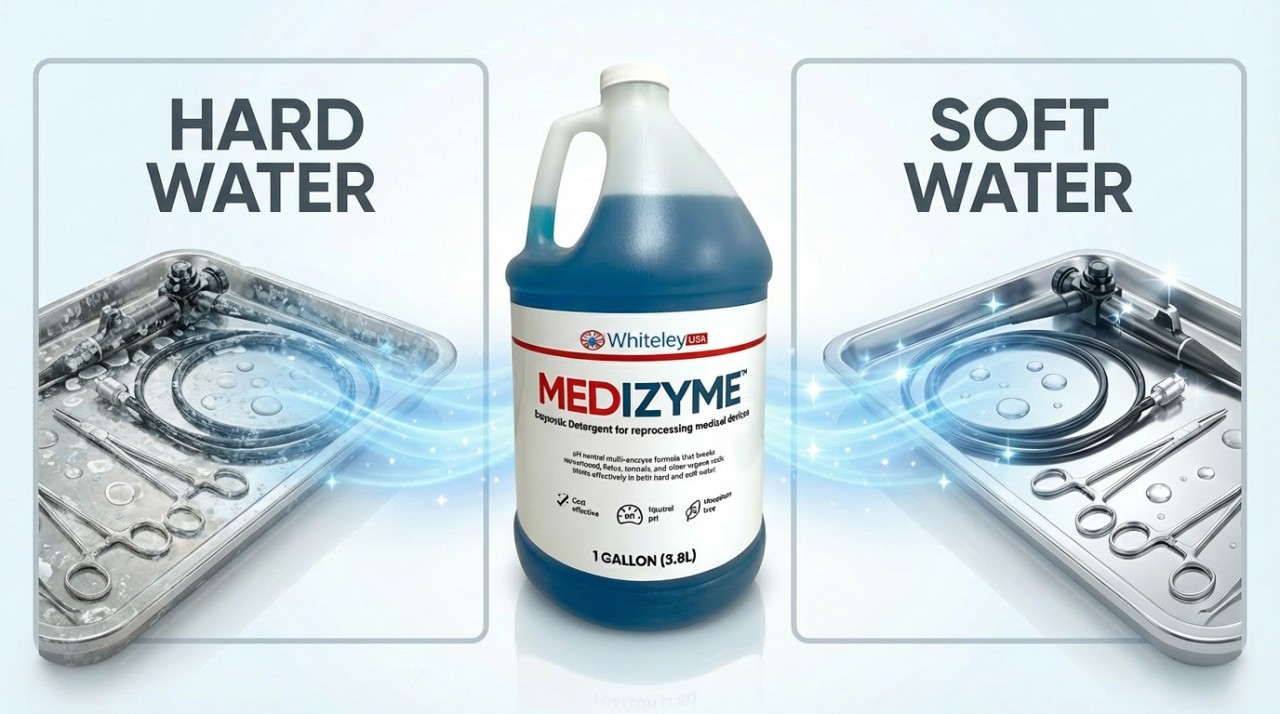
Water quality varies by location and season. Medizyme is designed to perform in hard water and soft water, which is helpful if you support multiple sites.
In practice, teams often see more consistent performance when they standardize Medizyme across both hard water areas and soft water areas. That consistency supports training, auditing, and repeatable routines on mixed sets.
Whiteley Medizyme is produced under ISO 9001:2008 quality certification, which helps facilities trust that each batch delivers consistent performance from one order to the next.
You shouldn't have to worry about your cleaning chemistry failing just because the local water is heavy with minerals. This specific enzyme detergent for surgical instruments is built to stay stable, so the active enzymes don't get tied up by water ions. It basically takes the guesswork out of the process. Your team can stick to the same soak times and concentrations every shift, knowing the bioburden will lift off just as easily in hard water as it does in soft.
How the Enzymes Work (and What They Remove)
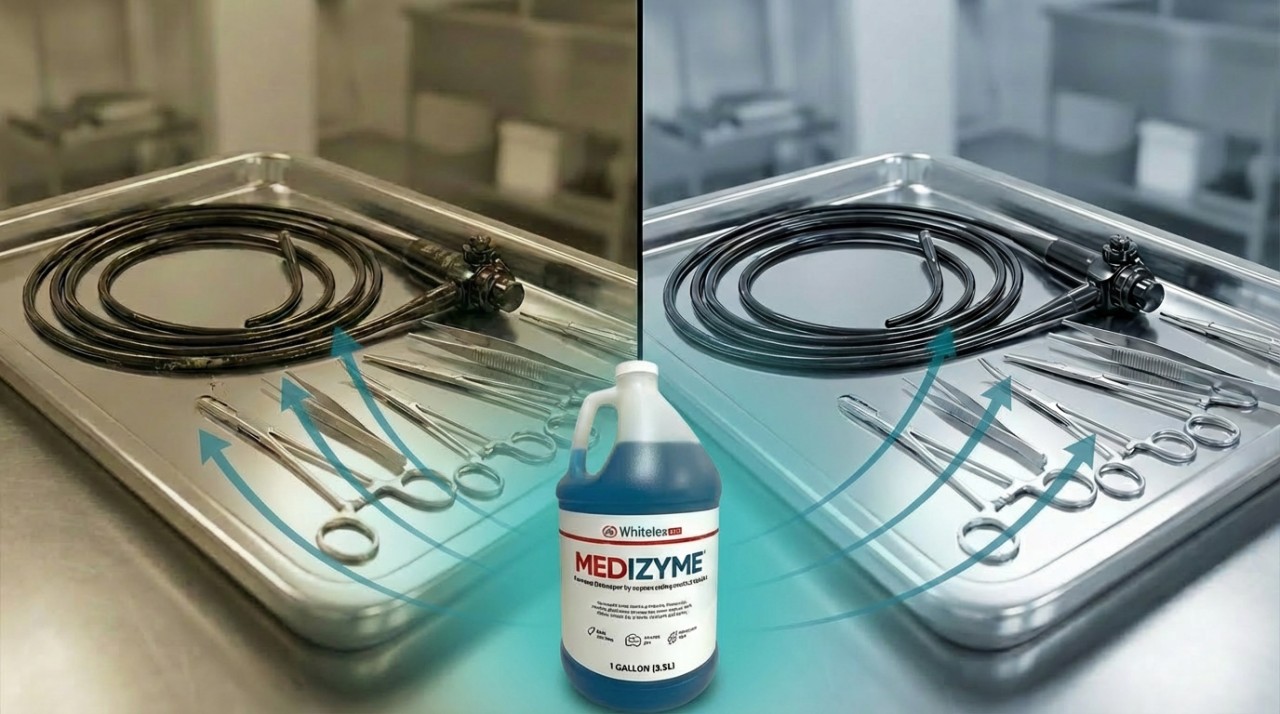
The enzymes in Medizyme are aimed at common soils found on instruments. Those enzymes help break down dried blood, tissue residue, carbohydrates, and lipids so technicians can complete their work without excessive force.
Medizyme is formulated to remove organic buildup such as dried blood, tissue, carbohydrates, and lipids that can collect in hinges, lumens, and serrations. By targeting those soils in the pre‑cleaning stage, the product helps devices move into the next phase of the cycle in a cleaner, more consistent state.
In real trays, you're rarely dealing with one soil type. A mix of blood, tissue, carbohydrates, and lipids is common, especially when sets sit before transport. Medizyme uses enzymes so that cleaning remains effective even when timing isn't perfect.
When staff follow a consistent routine, Medizyme supports effective cleaning on hinged tools, serrations, and other high‑risk surfaces. The enzymes keep working during soak time, and that can reduce repeat washes and minimize instrument rejection.
These enzymes are especially useful when soils have dried and the set is already on its way to inspection.
Getting the bioburden off complex tools requires more than just soap and water. Medizyme acts as a specialized medical instrument cleaner that physically breaks down the "glue" holding blood and tissue to surfaces. Because it targets proteins, starches, and fats simultaneously, it is the ideal pre-cleaning solution for endoscopes where internal channels are difficult to reach. By dissolving these contaminants at the molecular level, it ensures the equipment is truly ready for the next stage of disinfection.
Use on Different Instrument Surfaces
Medizyme is commonly used on reusable instruments from OR and procedural areas, but it's still smart to confirm compatibility for specialty instruments, equipment, and any unusual surfaces per IFU.
Whiteley Medizyme is designed to be safe for use on stainless steel, aluminum, medical‑grade plastics, and glass when used as directed. That broad compatibility helps departments standardize on one product across multiple trays and work areas instead of managing a different detergent for every material.
Medizyme can also be part of a broader routine for specialty equipment when staff need an effective option that is easy to train.
Medizyme and Standards for Reusable Medical Devices
Facilities that reprocess devices are under pressure to align with current standards and local policy. Whiteley Medizyme meets AS/NZS 4187 and AS/NZS 4815 standards for reprocessing reusable medical devices when used in accordance with relevant instructions. For managers, that alignment can make it easier to connect day‑to‑day practices with policy, accreditation, and audit expectations.
Endoscope reprocessing adds complexity because channels can trap residue. For scopes, circulation through narrow channels matters; if the solution doesn't move well, debris can stay behind and compromise the next stage.
Use the manufacturer IFU and facility policy to confirm contact time, dilution, and whether the next phase is high‑level disinfection. In general, disinfection is more reliable when the scope is visibly clean first. Disinfection is not a substitute for thorough cleaning, and the initial wash is the part staff control most.
Standardized Usage Guidelines
Start with the manufacturer directions and your facility protocol. Consistency beats improvisation.
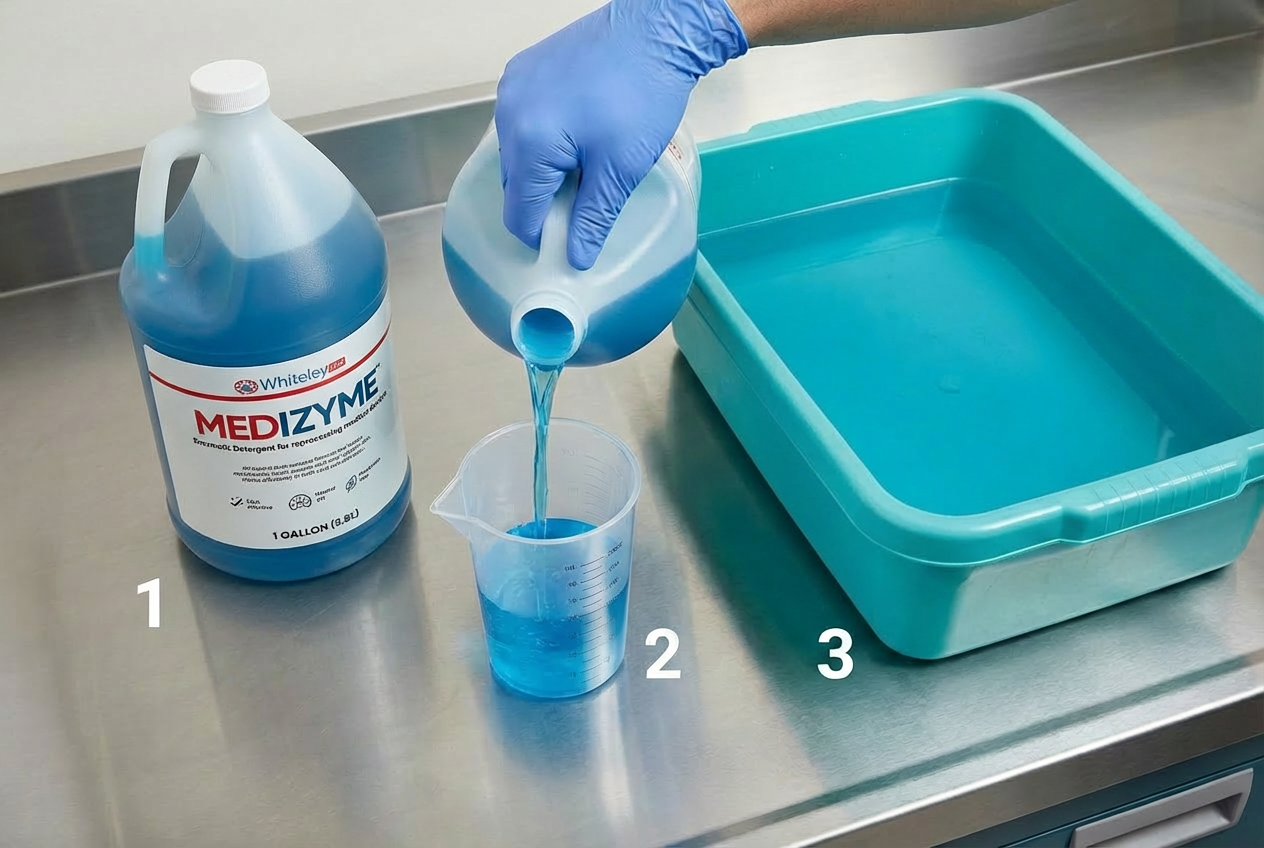
A simple workflow many teams follow:
- Mix to the correct dilution.
- Soak or flush as required.
- Rinse per policy.
- Move to the next stage without delays.
Departments that keep the routine simple typically get more predictable outcomes and fewer callbacks from inspection.
Cost and Operational Practicalities
If cost is part of your evaluation, compare it alongside labor time, rejects, and repeat washes — not just per‑ounce cost. Whiteley Medizyme is a cost‑effective option because of its concentrated formula; only a small amount is required for each cycle when staff follow the stated dilution.
Many facilities find the total cost picture becomes clearer once they track results for a month. Fewer repeat washes and more predictable results often matter more than the sticker price on a single container.
Staff Feedback and Outcomes
Frontline technicians usually care about two things: whether the product works, and whether the routine is sustainable. Medizyme is often described as effective when sets arrive late, soils are difficult, or staffing is thin. Many teams report that using a reliable surgical instrument pre-cleaner cuts down on the back-and-forth—no second-guessing whether something is actually clean before it moves to the next step.
For many teams, Medizyme is a product that makes the routine easier to train and easier to audit.
Medizyme also helps standardize expectations across technicians. That matters on a busy shift, when you need consistent output rather than heroic individual effort.
Evidence-Based Considerations (Without the Hype)
Independent research on enzymatic detergents is coming out regularly, and more research is coming that compares workflows and outcomes. What matters most is whether your team can execute the work the same way every time.
If you're auditing results, look for trends: fewer rejects, fewer repeat wash cycles, and less visible tissue residue in hinges. Those are outcomes you can explain to leadership.
Implementation Notes for Hospitals (Large, Mid-Size, and Small Facilities)
Large hospitals often benefit from standardization because Medizyme reduces variability between shifts and stations. Mid‑size facilities often adopt Medizyme to simplify training and reduce repeat work. Small facilities often choose Medizyme because the routine is easy to teach and still effective.
If you want to learn whether Medizyme fits your facility, bring your current workflow and your top failure points. We'll help you map Medizyme into existing steps without disrupting what already works, including how it integrates with adjacent equipment.
Final Takeaways
Notice the pattern across teams: consistent routines create consistent outcomes. Medizyme is a practical option for departments that want effective performance across variable water conditions (hard water and soft water), mixed sets, and variable staffing. If your job includes managing quality and throughput, keep the routine repeatable and the data will follow.
FAQs - Medizyme Multi-Enzymatic Detergent
Is Medizyme only for large hospitals?
No. Large hospitals often use Medizyme to reduce variability between shifts and stations. Mid‑size facilities use it to simplify training and reduce repeat work. Small facilities often choose it because the routine is easy to teach and still effective for mixed sets.
Where should Medizyme sit in the overall workflow?
Medizyme is intended for the pre‑cleaning stage. Use it early so organic buildup is addressed before disinfection or sterilization. Keeping this step consistent makes the rest of the cycle more predictable.
What should we watch during implementation?
Track rejects, repeat wash cycles, and visible residue in hinges and joints. Those are simple indicators that show whether your updated routine is working. Document dilution, temperature guidance, and contact time so new staff can follow the same pattern.
What is a multi-enzyme detergent, and why does it matter?
A multi-enzyme detergent contains more than one type of enzyme, each targeting a different kind of soil. Medizyme uses protease for proteins, amylase for carbohydrates, and lipase for fats. That combination means you're not just cleaning blood—you're also breaking down tissue, starch, and oils in one step. Single-enzyme products can leave gaps; multi-enzymatic detergents handle the full range of soils you see on real instruments.
Can Medizyme be used as a pre-cleaning enzymatic detergent?
Yes. Medizyme is designed specifically for the pre-cleaning stage. When used as a pre-cleaning enzymatic detergent, it loosens organic soils before instruments reach your washer-disinfector or AER. That early intervention keeps debris from hardening and makes the rest of your reprocessing workflow more predictable.
Is Medizyme safe for ultrasonic cleaners?
Absolutely. Medizyme works well as an ultrasonic cleaning detergent. It's low-foaming, so it won't interfere with cavitation, and the enzymes stay active during the ultrasonic cycle. Many facilities use the same dilution for manual and ultrasonic cleaning, which simplifies training and inventory.
What does "neutral pH" mean, and why does it matter for instrument reprocessing?
Neutral pH means Medizyme won't eat away at your instruments. Stainless steel, aluminum, plastics—they all hold up better when you're not hitting them with harsh alkaline or acidic cleaners. Over time, aggressive chemicals can pit hinges, corrode box locks, or dull surfaces. Medizyme keeps things clean without that trade-off.
Can Medizyme be used in automatic endoscope reprocessors (AERs)?
Not inside the AER itself—those machines need detergents that are validated by the manufacturer. Medizyme is for the manual cleaning step before the scope goes into the AER. You use it to get the bulk of the organic matter off first. That way, when the scope hits the AER cycle, the machine isn't fighting dried blood or tissue. It's just doing what it's designed to do: high-level disinfection on an already-clean surface.
What about lumens and hard-to-reach channels?
Yes. The enzymes in Medizyme work chemically, so they can reach internal channels and lumens where brushes can't go. When you flush or circulate the solution through difficult-to-reach areas, the enzymes break down dried debris without needing mechanical scrubbing. That's especially helpful for scopes and hinged instruments.
What is "point-of-use pre-cleaning," and does Medizyme support it?
Point-of-use pre-cleaning means treating instruments immediately after use—right at the bedside or in the procedure room—so soils don't dry. Medizyme can be part of that routine. Keeping instruments moist with an enzymatic solution during transport reduces the chance of biofilm formation and makes the cleaning step in your CSSD faster and more effective.
Is Medizyme considered an instrument reprocessing detergent?
Yes. It's meant for the reprocessing side of things, not general cleaning. People use Medizyme on reusable instruments because it plays nicely with SPD and endoscopy workflows and doesn't damage the equipment.
Does Medizyme leave any residue after rinsing?
No. Medizyme is free-rinsing, which means it doesn't leave a detergent film on instruments when rinsed properly. That's critical because any residue left behind can interfere with disinfection or sterilization. A free-rinsing formula also reduces the chance of spotting or staining on instruments.
Can Medizyme reduce the risk of biofilm on instruments?
Medizyme isn't a "biofilm killer" once a layer has already hardened, but it's great for stopping it before it starts. The trick is getting those organic soils off the instrument fast—before they have a chance to dry. If you clean them thoroughly right away, bacteria don't have the "anchor" they need to start building those protective layers. That's why that early pre-cleaning step is so big for long-term instrument safety.
What types of organic soils does Medizyme remove?
It's built to handle the standard mess you see on surgical and endoscope tools—things like dried blood, tissue, fats (lipids), and starches. Because it's a multi-enzyme blend, it doesn't just hit one type of soil; it breaks down a bit of everything. It even does a solid job on instruments that have been sitting for a while and have started to dry out before they hit the sink.
Is Medizyme compatible with washer-disinfectors?
Medizyme is used before the washer-disinfector cycle, not inside it. Most automatic washer-disinfectors require specific detergents validated by the equipment manufacturer. Medizyme's role is in the manual cleaning stage—removing the bulk of organic matter so the washer-disinfector can do its job without fighting dried-on debris.