
By Category
Blog Categories

Advantage Plus Parts & Service Guide

Complete Operation, Maintenance, Parts, and Service Guide
The Medivators ADVANTAGE PLUS AER is a computerized automated endoscope reprocessor built for busy hospital and surgical-center departments. It combines monitored cleaning and high-level disinfection steps with two independently operating basins, detailed cycle records, and scope-specific hookups. That automation helps standardize the process, but it does not replace trained staff. Point-of-use care, transport, inspection, correct hookup selection, chemistry checks, drying, storage, and documentation still matter.
For SPD teams, biomeds, and purchasing managers, the bigger question is how the machine fits the facility over its full service life. Configuration, utilities, preventive maintenance, alarm response, parts availability, and qualified technical support all affect uptime.
How the STERIS MEDIVATORS ADVANTAGE PLUS AER System Works
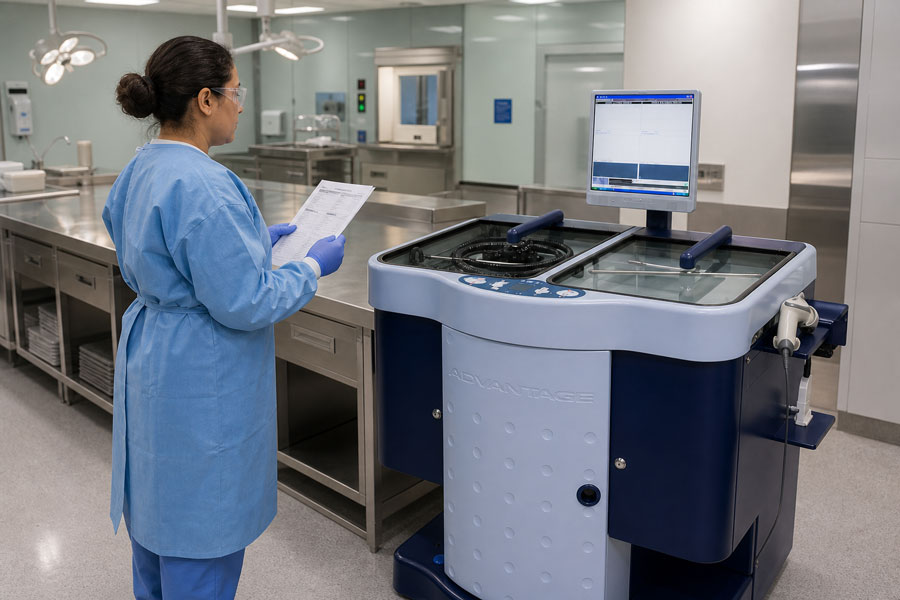
The standard ADVANTAGE PLUS endoscope reprocessor has two asynchronous basins. A facility can start a scope in one basin without waiting for the other side to finish. During processing, the system monitors connected channels for flow and blockage, continuously leak-tests the scope, and can perform a programmable alcohol flush to support channel drying. Barcode entry and computerized reporting help connect a cycle with the operator, endoscope, patient, physician, and result.
STERIS publishes an approximately 35-minute cleaning and high-level disinfection cycle for the standard reprocessing system. Actual processing requirements depend on the installed configuration, chemistry, software, endoscope, hookup, and current instructions for use.
High-Level Cleaning and Disinfection Process
A reliable endoscope reprocessing cycle begins before the scope reaches the automated endoscope reprocessor. Staff must complete point-of-use treatment and transport according to the endoscope manufacturer's IFU. In the reprocessing area, the operator inspects the scope, confirms the correct hookup, identifies the instrument, and verifies the required chemistry and test-strip procedure.
Once the cycle starts, the machine controls and monitors the programmed cleaning and level disinfection stages. Channel-flow monitoring and continuous leak testing are important safeguards: a connection, blockage, or leak problem should produce a fault instead of allowing an incomplete process to appear successful.
The standard machine has a validated automated-cleaning claim, but STERIS excludes duodenoscopes from that claim. Those devices require the manual cleaning and processing steps in the applicable scope and reprocessor IFUs. STERIS also states that RAPICIDE PA High-Level Disinfectant provides a five-minute exposure at 86°F (30°C). Confirm the current product label, temperature, concentration test, and exposure requirements before use.
After a passing cycle, staff still need to follow the required drying, handling, storage, and record-retention procedures. Automation reduces variation. It does not make those responsibilities optional.
Benefits of Dual-Basin Operation, Channel Monitoring, and Cycle Traceability
Independent basins help departments manage uneven demand. One delayed scope does not automatically hold up the second basin, and two endoscopes can begin and finish at different times. Scopes back up fast; that flexibility can protect room schedules.
The monitoring features also make problems visible. Channel-flow and blockage checks can reveal a restricted lumen or connection issue. Continuous leak testing helps protect the endoscope during processing. Computerized records give supervisors a practical trail for daily review, quality audits, and failed-cycle investigations.
Those records support traceability, but they should not be oversold. A stored report does not prove that an interrupted cycle was completed. Facilities should retain pass/fail status and associated cycle data according to policy and applicable standards.
Standard and Pass-Thru ADVANTAGE PLUS Automated Endoscope Reprocessors Compared
The standard and Pass-Thru versions serve different room designs. Both are automated endoscope reprocessors, but they should not be treated as interchangeable configurations.
Planning factor |
Standard ADVANTAGE PLUS |
ADVANTAGE PLUS Pass-Thru |
|
Access |
Loaded and unloaded from one side |
Installed through a wall for separate loading and unloading sides |
|
Workflow |
Fits a conventional reprocessing-room layout |
Supports unidirectional dirty-to-clean movement |
|
Basin operation |
Two asynchronous basins |
Configuration-specific workflow; verify current documentation |
|
Cleaning expectations |
Published automated-cleaning claim excludes duodenoscopes |
Confirm manual-cleaning and model-specific requirements in the current IFU |
|
Facility planning |
Requires verified power, water, drain, air, ventilation, network, and service clearances |
Also requires wall, room-separation, and clean-side access planning |
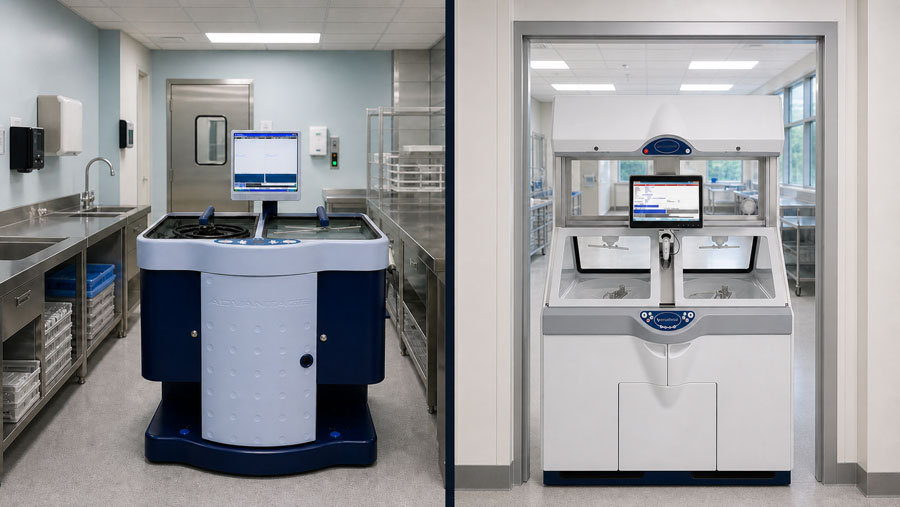
STERIS uses the hyphenated name ADVANTAGE PLUS Pass-Thru. Search tools may show phrases such as “ADVANTAGE PLUS pass thru” or “plus pass thru,” but the official product name should be used in specifications and purchasing records.
Which ADVANTAGE PLUS Reprocessing System Fits Your Workflow?
Start with movement through the department. If the facility wants a physical barrier between receiving and clean-side unloading, the ADVANTAGE PLUS Pass-Thru may better support that design. A standard unit can be the more practical choice where both loading and unloading occur from the same work area.
Then look at demand, redundancy, staffing, wall construction, renovation tolerance, utilities, network access, and service clearance. For North American standard systems, model ADV-1007 includes an air compressor; ADV-1008 does not. That choice changes the external compressed-air plan. Model availability can change, so confirm the current ordering information before treating those numbers as universal.
Compatible Products, Endoscopes, Utilities, and Installation Requirements
Endoscope reprocessing compatibility is specific, not visual. Two connectors or products may look similar and still be wrong for the machine or scope. Before purchasing, installing, relocating, or adding an instrument, verify the exact system model, software/configuration, endoscope, hookup, chemistry, filter, and utility requirements.
Endoscope Compatibility, Hookups, and RAPICIDE PA Products
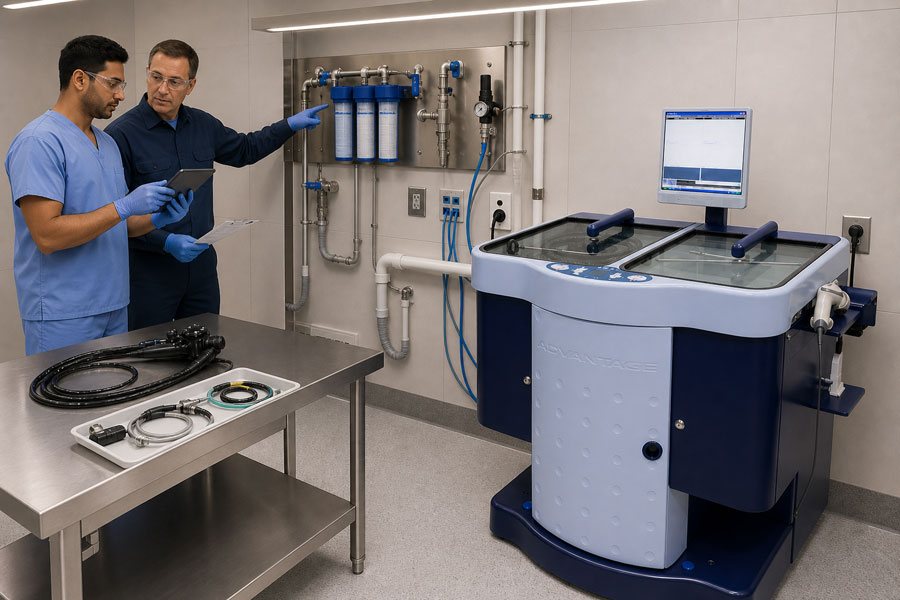
Use the current STERIS Device Compatibility Matrix together with the endoscope and reprocessor IFUs. That combination identifies whether a scope can be processed and which hookup is required. Do not select a connector based only on brand, channel count, or appearance.
The standard North American workflow uses compatible INTERCEPT detergent and RAPICIDE PA disinfectant products, along with the correct test strips, filters, and connectors. But confirm the chemistry labeling, contact time, temperature, concentration testing, expiration or shelf life, and storage requirements. Substituting a product because it fits the container or resembles the original creates avoidable risk.
When a facility adds new endoscopes, document the compatibility review before placing them into service. Keep the hookup identification and parameter information available to operators.
Power, Water, Drain, Network, and Air-Compressor Requirements
Published planning values for the standard unit include:
- 100–240 VAC, single phase, 50/60 Hz power
- At least 1.32 GPM (5 LPM) water flow at 35–87 PSI (2.4–6 bar)
- Water hardness below 12 gpg (200 ppm)
- A vented drain capable of 3.17 GPM (12 LPM)
- When air is externally supplied, dry oil-free air at 58–145 PSI (4–10 bar) and at least 1.5 CFM
These numbers are planning data, not a substitute for the technical data sheet for the exact model. Facilities should also verify ventilation, network and reporting needs, environmental limits, service access, and local electrical and plumbing requirements. A utility that is technically present but unstable can still cause interrupted cycles.
Preventive Maintenance and Technical Service for Automated Endoscope Reprocessors
Preventive maintenance protects more than the machine. It supports predictable processing capacity and helps prevent a small wear item from becoming a day-long shutdown. Use the current model-specific maintenance schedule and facility policy for task intervals.
Daily operator work generally centers on inspection, cleaning, approved consumables, chemistry controls, visible connections, and documentation specified in the IFU. Scheduled work may involve filters, seals, dosing components, pumps, valves, sensors, the computer and reporting hardware, and safety checks. The exact list and return-to-service procedure belong to the current technical documentation.
Daily Checks, Scheduled PM, and Qualified Technical Service
Operators should look for changes they can see or document: damaged hookups, residue, unusual sounds, recurring warnings, chemistry concerns, printer or barcode problems, and incomplete cycle records. If a required check fails, do not work around it to keep production moving.
Qualified technical service becomes necessary when faults recur after permitted operator actions, utilities meet specifications but cycles continue to abort, internal adjustment is indicated, or a leak or electrical problem is suspected. STERIS technician training for these automated endoscope reprocessors covers theory of operation, preventive maintenance schedules, troubleshooting, and adjustments. Remote support and run reports can speed diagnosis, but they do not replace proper repair and post-service verification.
Common ADVANTAGE PLUS Problems, Alarms, and Troubleshooting
Use the alarm shown on the machine—not a remembered description. The MEDIVATORS operator manual uses S codes for system or control messages, W codes for warnings, and F numbers within some channel-monitoring reports. Record the complete code, affected basin, cycle stage, scope, hookup, and run-report information before contacting service. Never bypass a failed cycle or document it as complete.
Channel-Flow, Leak-Test, and Hookup Faults
The manufacturer’s control-error tables explain that a high channel-flow error can be associated with a pump, valve, or sensor problem. A low reading may be caused by a partially blocked channel or terminal connection. Those are possible causes listed by MEDIVATORS, not a diagnosis for every machine.
Leak-test and hookup faults must be handled according to the exact code and the current operator manual. Staff should verify only items the IFU authorizes them to check. Do not swap scopes, hookups, or basins as a diagnostic experiment unless the documented procedure and facility policy allow it. Do not bypass monitoring, open internal assemblies, or adjust components to clear an alarm. When the manual says to report the problem to maintenance, the operator action ends there.
For an S-300 control error, the manual states that the active phase stops and the program automatically enters a safe post-rinse rundown. Follow the displayed instructions and treat the run as interrupted.
Utility, Chemistry, Barcode, Printer, and Data Faults
Other interruptions can involve water, drain, temperature, compressed air, chemistry, the lid, barcode entry, printing, networking, or run-report data. Match the displayed code to the current manual rather than applying a generic reset.
The operator manual gives several clear examples. For W-713, “lid will not close,” check for a visible obstruction; if none is visible, report the issue to maintenance. For W-744, “minimum level high,” close the cover so the basin can drain, then report the warning to maintenance. W-810 instructs the operator to open the lid to complete the cycle and follow the onscreen prompts.
Clearing a warning does not validate a failed run. Capture the message, cycle stage, relevant utility readings, chemistry status, and data-system symptoms. Then follow the manufacturer’s stated response and the facility escalation path.
ADVANTAGE PLUS Parts and Service Support from MedService Repair
Ownership planning should include common wear and maintenance categories without turning this guide into a parts catalog. MedService Repair supplies OEM-compatible options for Medivators ADVANTAGE PLUS automated endoscope reprocessors, along with refurbished equipment and free phone troubleshooting. Before ordering, confirm the model, serial or configuration information, exact part number, and current documentation.
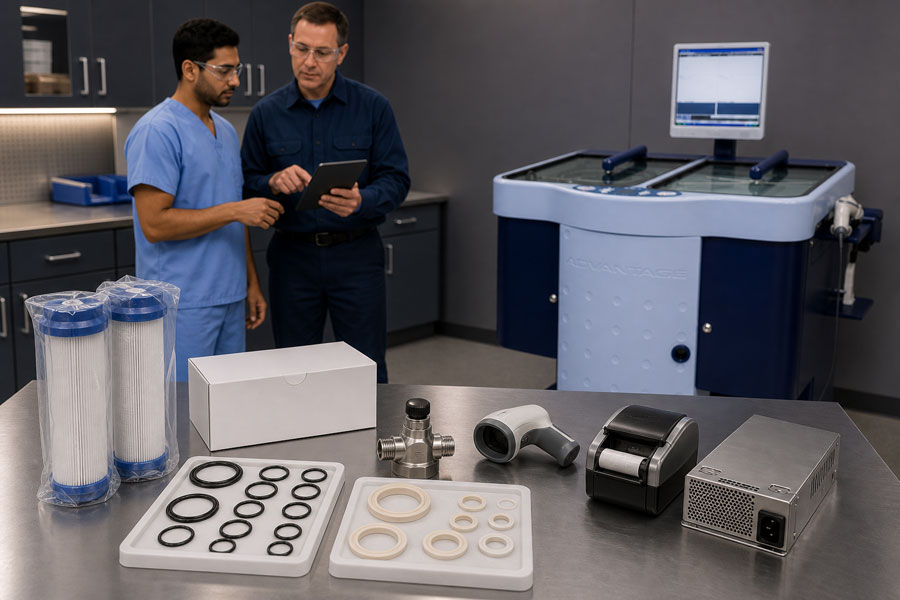
For component-level coverage, use the Medivators ADVANTAGE PLUS parts guide. It covers the inventory side in more detail without duplicating the operational guidance here.
Filters, PM Kits, Valves, Electronics, and Frequently Purchased Parts
Facilities commonly plan for filters and preventive-maintenance kits, O-rings and seals, dosing and flow-control components, scanners, printers, power supplies, and computer assemblies. What gets replaced—and when—depends on the exact configuration, condition, schedule, and diagnosis.
When requesting a quote or troubleshooting help, provide the machine model, serial number when relevant, part number if known, affected basin, displayed code, symptom, cycle stage, recent maintenance, and utility or chemistry details. Better information shortens the path from symptom to the correct component.
Replacement intervals, installation, calibration, and return-to-service checks must follow the model documentation and facility policy. A compatible component is only part of the job; the system must also be verified before clinical use.
Contact MedService Repair for Nationwide ADVANTAGE PLUS Support
Contact MedService Repair when your team needs ADVANTAGE PLUS parts, refurbished equipment options, or help narrowing a machine problem. Have the configuration, alarm code, affected basin, cycle stage, scope and hookup details, recent maintenance, chemistry status, and available utility readings ready.
MedService Repair supports facilities nationwide with OEM-compatible parts and free phone troubleshooting. Contact the team before ordering when compatibility is uncertain—the right details can prevent the wrong part, reduce downtime, and help determine whether the next step belongs to the operator or a qualified technician.
*Manufacturer references:*
- MEDIVATORS ADVANTAGE PLUS User Manual, Chapter 5: Errors and Troubleshooting
- STERIS ADVANTAGE PLUS Automated Endoscope Reprocessor
Always follow the current manufacturer IFU, chemistry labeling, facility policy, and applicable standards. This article does not replace model-specific operating or service documentation.
